
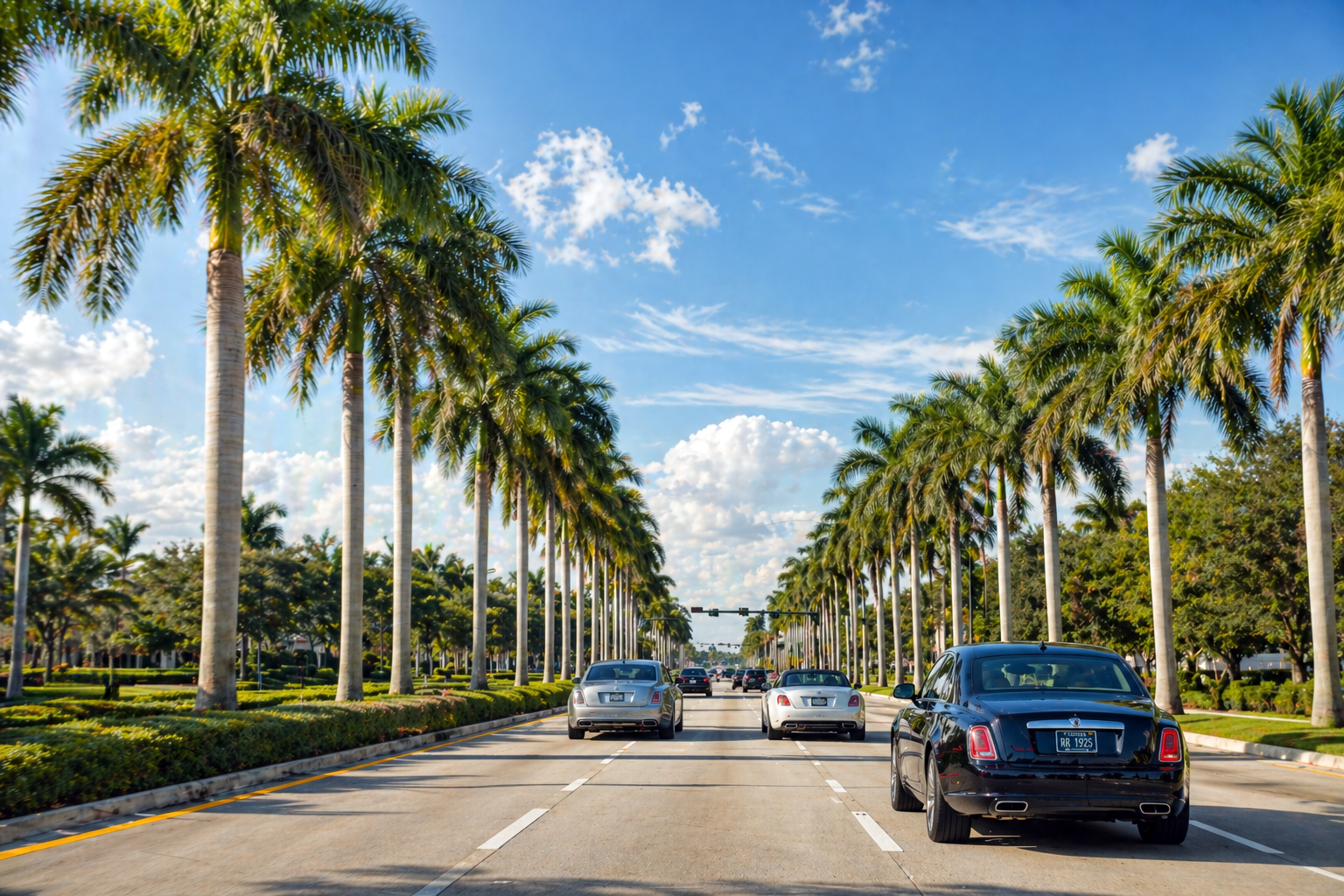
You've moved to Florida. You've unpacked the boxes, enrolled the kids, and found your go-to coffee shop. Now it's time to talk about the thing you'll do more of here than almost anywhere else you've lived: drive.
Florida is a car state. Public transit exists in pockets, but for the vast majority of residents — especially in the suburbs of Southeast Florida — a car is your lifeline. And driving here comes with its own set of rules, costs, quirks, and unspoken customs that newcomers figure out the hard way if nobody tells them first.
Consider this your briefing.
Switching Your Driver's License: The Clock Is Ticking
Florida law requires new residents to obtain a Florida driver's license within 30 days of establishing residency. That timeline is tighter than most people expect, and the process involves more than showing up at the DMV.
You'll need to visit a Florida Department of Highway Safety and Motor Vehicles (DHSMV) office — not a tax collector's office in every county — with the following documents: proof of identity (passport or birth certificate), proof of Social Security number, two proofs of Florida residential address (utility bill, bank statement, lease agreement), and your current out-of-state or international license.
If you're coming from another US state, you'll surrender your old license and take a vision test. Written and road tests are typically waived if your out-of-state license is valid. If you're coming from another country, the process is more involved. International licenses are valid for short-term visits, but once you become a Florida resident, you'll need to pass the written knowledge test, a road signs test, and a driving skills test. An International Driving Permit can be used alongside your foreign license as a temporary bridge, but it's not a substitute for a Florida license once residency is established.
Pro tip: Make an appointment online before going to the DHSMV office. Walk-in wait times can be brutal, especially in Palm Beach and Broward counties.
Car Insurance: Brace Yourself
Here's the part that catches everyone off guard: Florida has some of the highest car insurance rates in the entire United States. The statewide average for full coverage is well above the national average, and in South Florida specifically, rates are even higher due to population density, traffic volume, and the state's unique legal environment around auto claims.
Florida is a no-fault insurance state, which means your own insurance covers your medical expenses after an accident regardless of who caused it. The minimum required coverage includes $10,000 in Personal Injury Protection (PIP) and $10,000 in Property Damage Liability. But these minimums are dangerously low — most financial advisors and insurance agents will strongly recommend carrying far more coverage than the state minimum.
A few things to know:
Bodily Injury Liability is not required by the state but is essential. If you cause an accident and someone is seriously injured, you can be personally liable for hundreds of thousands of dollars without it.
Uninsured motorist coverage is critical. Florida has one of the highest rates of uninsured drivers in the country — roughly one in five. Protecting yourself against an accident caused by an uninsured driver is not optional in practice, even if it is in law.
Shop aggressively. Rates vary dramatically between carriers. Get quotes from at least four or five companies, and consider working with an independent insurance broker who can compare across multiple carriers.
Your address matters. Moving from one neighborhood to another — even within the same county — can change your premium by hundreds of dollars. Zip codes in high-density, high-traffic areas carry higher rates.
Toll Roads: SunPass, E-PASS, and Why You Need One Immediately
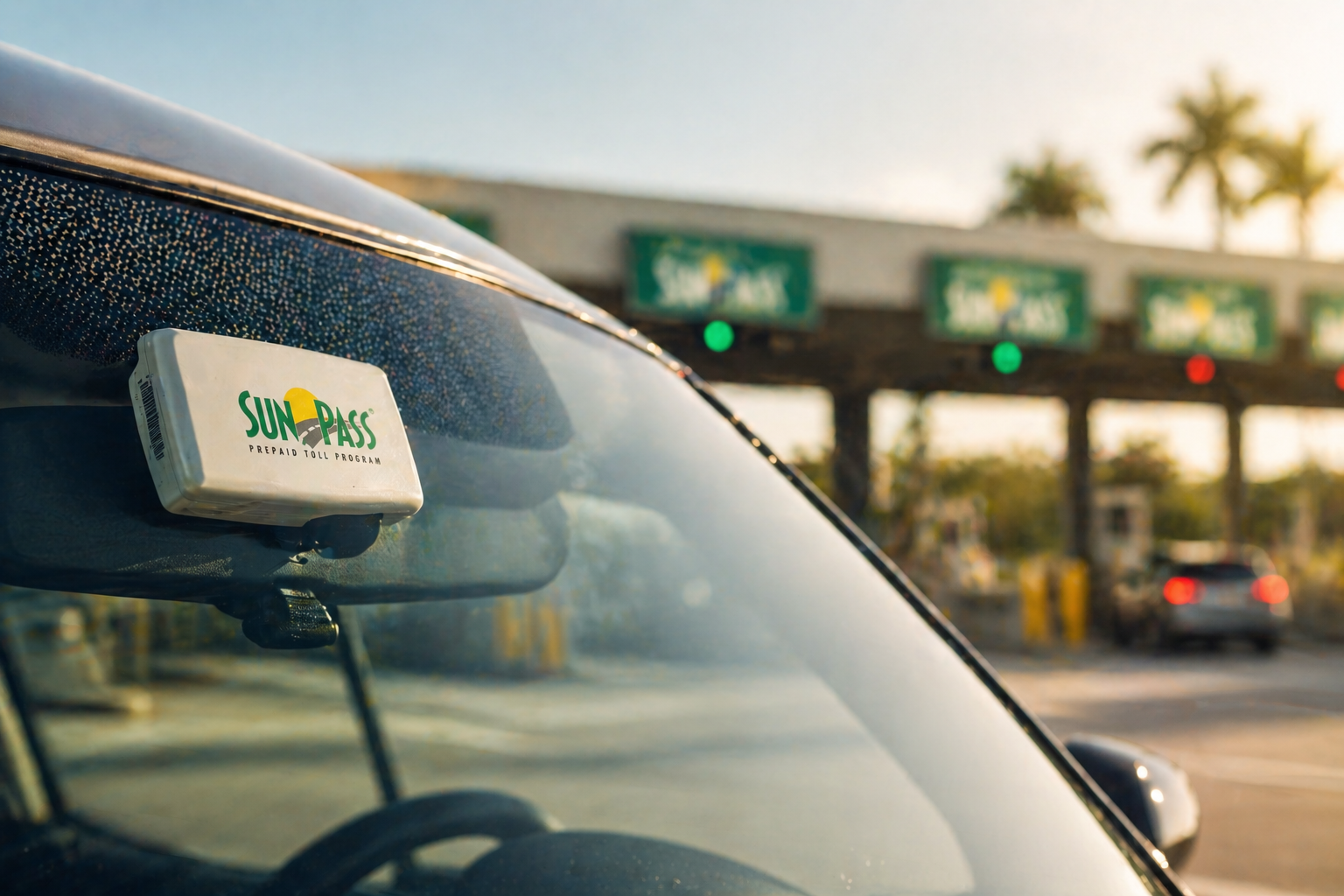
South Florida's highway system runs on tolls. The Florida Turnpike, Sawgrass Expressway, I-95 Express Lanes, and numerous bridges and causeways all charge tolls — and almost all of them are cashless. If you drive through a toll without a transponder, a camera photographs your plate and you'll receive a bill in the mail at a significantly higher rate.
The solution is to get a SunPass transponder as soon as you arrive. You can buy one online, at Publix, CVS, or Walgreens, and activate it in minutes. SunPass is accepted on all Florida toll roads and is interoperable with E-PASS (used primarily in Central Florida) and several other regional systems.
If you have a rental car during your initial transition period, check whether the rental company charges its own toll fees — these are often marked up substantially. Using your own SunPass mini, which sticks to your windshield and transfers between vehicles, is almost always cheaper.
Registration and Vehicle Titling
New residents must register their vehicles in Florida within 30 days. You'll need to visit your county's tax collector office (this is different from the DHSMV office where you get your license) with your current out-of-state title or registration, proof of Florida insurance, and a VIN verification (some counties handle this at the office; others require a separate inspection).
Florida charges a one-time initial registration fee plus annual renewal fees, and you'll owe sales tax on the vehicle if you purchased it recently or are bringing it from a state where you didn't pay equivalent sales tax. This can be a meaningful expense on high-value vehicles.
If you're leasing, contact your leasing company to notify them of the state change — they'll handle the title, but you'll still need to update your registration and plates.
The Unwritten Rules
Every state has its driving culture, and Florida's is... distinctive. Here are the things nobody puts in the manual:
Left lane discipline is weak. You will encounter people cruising in the left lane at 60 mph on I-95. This is infuriating and ubiquitous. Adjust your expectations and your blood pressure accordingly.
Turn signals are aspirational. Many Florida drivers treat turn signals as optional. Defensive driving isn't just recommended here — it's survival.
Afternoon thunderstorms are real hazards. From June through September, South Florida gets near-daily afternoon thunderstorms that can reduce visibility to near zero in seconds. When it pours, slow down dramatically, turn on your headlights (it's the law), and if necessary, pull over and wait it out. These storms rarely last more than 30 to 45 minutes.
Snowbird season changes everything. From November through April, the population of South Florida swells with seasonal residents — many of them elderly — who aren't familiar with local roads. Traffic patterns shift, parking gets tighter, and patience becomes a necessity.
Roundabouts are multiplying. South Florida has been adding roundabouts at an increasing rate, and many local drivers have no idea how to use them. Know the rules (yield to traffic already in the circle, signal your exit) and drive defensively.
Right on red is legal (usually). Unless posted otherwise, you can turn right at a red light after coming to a complete stop and yielding to traffic and pedestrians. Visitors from countries where this isn't permitted often sit at red lights wondering why everyone behind them is honking.
Parking: A Few Notes
If you're used to city living where street parking is the norm, Florida's approach will feel different. Most residential areas have ample driveway or garage parking. Commercial areas rely heavily on parking lots, and many waterfront and downtown areas have metered parking — increasingly managed through apps like ParkMobile.
Beach parking in popular areas (Delray Beach, Fort Lauderdale Beach, Palm Beach) can be competitive during peak hours and peak season. Resident parking permits are available in some municipalities and are worth getting if you live near the coast.
The Bottom Line
Driving in Florida is easy once you know the system. The roads are flat, well-maintained, and rarely icy. The infrastructure is designed for cars, and once you have your license, insurance, SunPass, and registration sorted, the logistics fade into the background. The adjustment period is real but short. Within a month or two, you'll navigate I-95 like a local, have your favorite route to the beach memorized, and wonder how you ever lived somewhere with parallel parking and congestion charges.
Relocating to Florida and want help getting the logistics sorted before you arrive? Adam Jacobs helps families plan every step of the transition — including the ones that seem small until you're dealing with them at 2 p.m. on a Tuesday at the DMV. Reach out at adam@jacobsrelocation.com.